
Static Electricity:7 powerful facts, Causes, Examples, and Applications
Introduction
Have you ever experienced a small electric shock after touching a metal door handle? Or noticed your hair standing up after removing a woollen sweater? These everyday experiences are examples of static electricity.
Static electricity is an important concept in physics and electrical engineering. It explains how electric charges accumulate on the surface of materials and how these charges interact with nearby objects.
Static electricity plays an important role in many modern technologies, including photocopiers, laser printers, electrostatic precipitators, and industrial painting systems.
In this article, we will understand the meaning of static electricity, its causes, types of electric charges, working principles, mathematical relationships, examples, and engineering applications.
1. What Is Static Electricity?
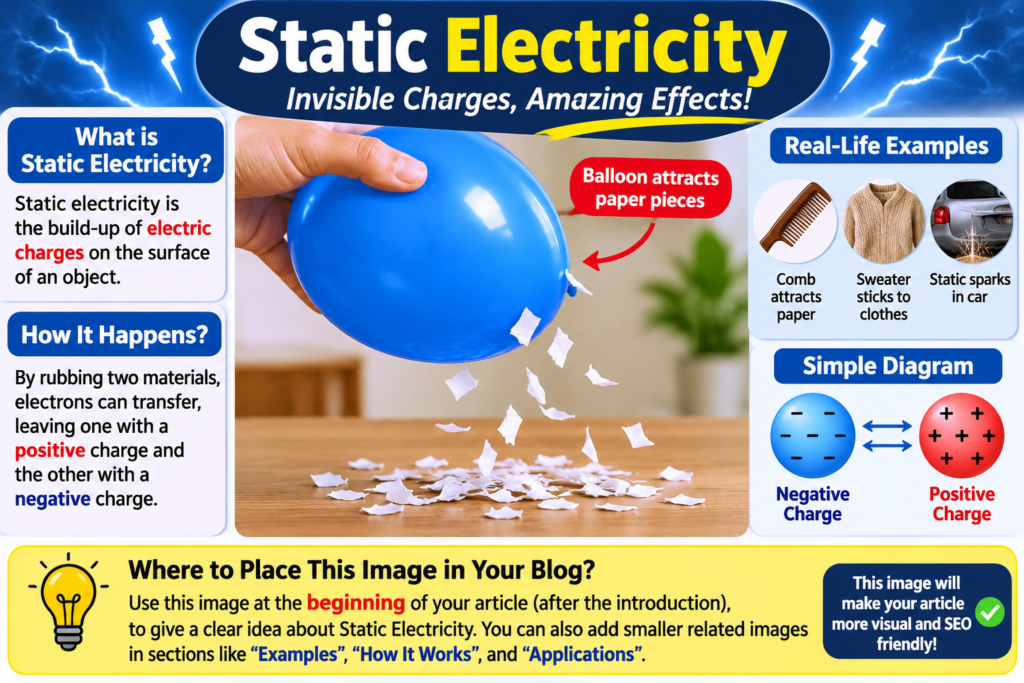
Static electricity is the accumulation of electric charges on the surface of an object. These charges remain stationary or nearly stationary until they find a path to move or discharge.
The word “static” means stationary. Unlike electric current, in which electric charges flow continuously through a conductor, static electricity involves an imbalance of electric charges.
An object normally contains equal numbers of positively charged protons and negatively charged electrons. When electrons transfer from one material to another, an imbalance develops.
An object that gains electrons becomes negatively charged, while an object that loses electrons becomes positively charged.
2. How Is Static Electricity Produced?
Static electricity is mainly produced through the transfer of electrons between two materials.
There are three common methods of charging objects:
2.1 Charging by Friction
Charging by friction occurs when two different materials are rubbed against each other.
During rubbing, electrons may transfer from one material to another because the materials have different tendencies to attract electrons.
For example:
- Rubbing a plastic comb against dry hair.
- Rubbing a balloon against woollen clothing.
- Walking on a carpet while wearing certain types of shoes.
After rubbing, the two materials may acquire opposite electric charges.
2.2 Charging by Conduction
Charging by conduction occurs when a charged object directly touches another object.
During contact, electrons can move between the objects, changing their electric charge.
For example, when a negatively charged metal object touches a neutral metal sphere, some electrons may transfer to the sphere.
2.3 Charging by Induction
Charging by induction occurs when a charged object causes the redistribution of electric charges in another object without direct contact.
For example, when a negatively charged rod is brought near a neutral metal sphere, electrons in the sphere move away from the rod.
This creates charge separation within the sphere. With proper grounding and removal of the external rod, the sphere can acquire a net charge.
3. Types of Electric Charges
Electric charges are of two types:
3.1 Positive Charge
An object becomes positively charged when it loses electrons.
A positively charged object has fewer electrons than protons.
3.2 Negative Charge
An object becomes negatively charged when it gains additional electrons.
A negatively charged object has more electrons than protons.
Law of Electric Charges
The interaction between electric charges follows two basic rules:
- Like charges repel each other.
- Unlike charges attract each other.
For example, two positively charged objects repel each other, while a positively charged object and a negatively charged object attract each other.
4. Coulomb’s Law of Electrostatic Force
Coulomb’s law describes the electrostatic force between two stationary point charges.
According to Coulomb’s law, the magnitude of the electrostatic force is directly proportional to the product of the two charges and inversely proportional to the square of the distance between them.
The mathematical expression is:
F = k × (|q₁ × q₂| / r²)
Where:
- F = Electrostatic force (Newton)
- q₁ = First electric charge (Coulomb)
- q₂ = Second electric charge (Coulomb)
- r = Distance between the charges (metre)
- k = Coulomb’s constant
In vacuum:
k ≈ 8.99 × 10⁹ N m²/C²
Numerical Example
Suppose two point charges of 2 μC and 3 μC are separated by a distance of 0.5 metres in vacuum.
Find the electrostatic force between them.
Given:
q₁ = 2 × 10⁻⁶ C
q₂ = 3 × 10⁻⁶ C
r = 0.5 m
Using Coulomb’s law:
F = k × (|q₁ × q₂| / r²)
F = 8.99 × 10⁹ × [(2 × 10⁻⁶ × 3 × 10⁻⁶) / (0.5)²]
F ≈ 0.216 N
Therefore, the magnitude of the electrostatic force is approximately 0.216 Newton.
Since both charges are positive, the force is repulsive.
5. Electric Field
An electric field is the region around an electric charge in which another electric charge experiences an electrostatic force.
The electric field intensity is defined as the force experienced per unit positive test charge.
Its mathematical expression is:
E = F / q
Where:
- E = Electric field intensity (N/C)
- F = Electric force (N)
- q = Test charge (C)
The SI unit of electric field intensity is Newton per Coulomb (N/C).
For a point charge in vacuum:
E = k × |Q| / r²
The direction of the electric field is away from a positive charge and towards a negative charge.
6. Everyday Examples of Static Electricity
Static electricity can be observed in several everyday situations.
6.1 Balloon and Hair
When a balloon is rubbed against dry hair, electrons may transfer between the two materials. The resulting electrostatic attraction can make the balloon stick to a wall.
6.2 Electric Shock from a Metal Door Handle
When a person walks across a carpet, friction can cause an electric charge to accumulate on the body.
When the person touches a metal door handle, the accumulated charge may discharge suddenly, producing a small spark or electric shock.
6.3 Clothes Sticking Together
During washing and drying, clothes can develop static charges due to contact and separation. Oppositely charged clothes may attract each other.
6.4 Lightning
Lightning is a large-scale electrical discharge associated with charge separation in clouds and between clouds and the ground.
When the electric field becomes sufficiently strong, electrical breakdown of air occurs, producing a lightning discharge.
7. Applications of Static Electricity in Engineering
Static electricity is useful in many industrial and engineering applications.
7.1 Photocopiers
Photocopiers use electrostatic principles to transfer toner particles onto paper.
An electrostatic charge pattern is created on a photoconductive surface. Toner particles are attracted to the appropriate regions and transferred to paper, where heat helps fix the image.
7.2 Laser Printers
Laser printers use electrostatic attraction to control the movement of toner particles.
A charged photosensitive drum develops an image pattern, and toner sticks to the required regions before being transferred to paper.
7.3 Electrostatic Precipitators
Electrostatic precipitators are used in industries and power plants to remove dust and fine particles from exhaust gases.
Particles receive an electric charge and are attracted towards oppositely charged collecting plates.
This technology helps reduce particulate air pollution.
7.4 Electrostatic Spray Painting
Electrostatic spray painting is used to improve the efficiency of industrial painting.
Paint droplets receive an electric charge and are attracted towards a grounded or oppositely charged object.
This helps produce a more uniform coating and can reduce paint wastage.
7.5 Electrostatic Separation
Electrostatic separation is used in certain industrial processes to separate materials according to their electrical properties.
It can be applied in mineral processing and material recycling.
8. Advantages and Disadvantages of Static Electricity
Advantages
- Used in photocopiers and laser printers.
- Helps remove dust and smoke particles from industrial gases.
- Improves the efficiency of electrostatic spray painting.
- Useful in certain material separation processes.
Disadvantages
- Can produce unwanted sparks.
- May damage sensitive electronic components.
- Can create fire or explosion hazards in environments containing flammable gases, vapours, or dust.
- May cause discomfort through small electric shocks.
9. How Can Static Electricity Be Prevented?
Static electricity can be controlled using several engineering methods.
- Grounding: Provides a safe path for accumulated electric charge to flow away.
- Antistatic Materials: Special materials help reduce charge accumulation.
- Humidity Control: Suitable humidity can reduce static charge buildup in many environments.
- Conductive Flooring: Helps dissipate accumulated charges in industrial and electronic workspaces.
- Antistatic Wrist Straps: Used by electronics technicians to protect sensitive electronic components.
In hazardous industrial environments, proper bonding, grounding, and equipment designed for the specific hazard are essential.
10. Difference Between Static Electricity and Current Electricity
| Static Electricity | Current Electricity |
|---|---|
| Charges accumulate on surfaces or within objects. | Electric charges flow through a circuit. |
| Charges are generally stationary before discharge. | Charges move continuously when current flows. |
| May produce sudden electric discharge. | Can provide continuous electrical energy. |
| Example: Charged balloon. | Example: Current flowing through a wire. |
11. Frequently Asked Questions (FAQs)
Q1. What is static electricity in simple words?
Static electricity is the accumulation of electric charges on an object’s surface due to an imbalance between positive and negative charges.
Q2. What causes static electricity?
Static electricity is commonly caused by electron transfer between materials through friction, contact, or induction.
Q3. Why does static electricity produce sparks?
A spark occurs when accumulated electric charge suddenly moves through air or another insulating medium after the electric field becomes strong enough to cause electrical breakdown.
Q4. Is static electricity dangerous?
Small static discharges are usually harmless to people, but sparks can be dangerous around flammable gases, vapours, and combustible dust. Static discharge can also damage sensitive electronic equipment.
Q5. What is the SI unit of electric charge?
The SI unit of electric charge is the Coulomb (C).
Q6. What is the difference between static electricity and current electricity?
Static electricity involves the accumulation of electric charges, whereas current electricity involves the continuous movement of electric charges through a conductor or circuit.
Q7. Where is static electricity used?
Static electricity is used in photocopiers, laser printers, electrostatic precipitators, spray painting, and industrial material separation.
Conclusion
Static electricity is an important concept in physics and electrical engineering. It occurs when electric charges accumulate due to an imbalance between positive and negative charges.
Its principles explain everyday experiences such as small electric shocks, charged balloons, and lightning. Beyond everyday observations, static electricity has important applications in industrial pollution control, printing technology, and manufacturing.
Understanding static electricity helps students and engineers understand electrostatic forces, electric fields, electrical safety, and several practical engineering technologies.